

Dermal Papilla Cell Hair Replacement: Lasting Restoration

People experiencing hair loss typically try multiple interventions, investing considerable time and money whilst hoping for lasting improvement. Specialist shampoos accumulate on shelves. Scalp massage routines continue faithfully. Pharmaceutical treatments require endless continuation. Nutritional supplements promise results that never quite materialise. Despite these efforts and expense, hairlines continue receding regardless of compliance.
Understanding why conventional approaches fail to deliver sustained results requires examining how these methods interact with follicular biology, and more importantly, why they cannot restore function once fundamental cellular capacity has declined.
Why Medications and Topical Treatments Fail
Pharmaceutical treatments including minoxidil and finasteride represent common first-line interventions. These medications can effectively slow hair loss progression, but they function as symptom control rather than restoration.
Finasteride suppresses dihydrotestosterone production, reducing hormonal attack on follicles. Cessation causes rapid hormone level rebound, and follicular miniaturisation resumes immediately. Minoxidil extends follicular growth phases and dilates scalp blood vessels, promoting temporary growth that reverses when treatment stops. Scalp irritation and inflammation occur commonly with continued use.
Topical care approaches including anti-hair loss shampoos, scalp massage and various traditional remedies primarily affect the scalp surface. These interventions may temporarily improve cleansing, briefly enhance microcirculation or provide psychological comfort. However, they cannot address follicles undergoing programmatic atrophy driven by hormonal and environmental factors. Whilst suitable for daily maintenance, these approaches prove insufficient for meaningful regeneration.
Why Surgery, Injections and Nutrition Fall Short
Surgical hair transplantation provides effective visual coverage for advanced hair loss by redistributing existing follicular resources. The procedure cannot increase total follicle numbers or prevent continued loss of native hair. Results depend heavily on available donor follicles, surgical skill and post-operative care, with outcomes varying considerably between individuals.
Injectable therapies including exosomes, microneedling and platelet-rich plasma have gained attention for their ability to secrete growth factors, reduce inflammation and improve follicular microenvironments. Growth signals prove difficult to sustain and frequently interrupt, causing regenerative processes to stall before achieving meaningful results.
Many people assume nutritional deficiencies drive their hair loss and focus intensively on supplementation. Follicles do require substantial nutrition. Protein builds hair shaft structure. Iron enables oxygen delivery. Vitamins support metabolic processes. Zinc facilitates cellular division. Protein deficiency causes new hair to emerge fine and fragile, entering resting phases prematurely. Iron deficiency creates follicular hypoxia, leading to diffuse thinning. Vitamin insufficiency degrades hair quality and shortens growth cycles. Zinc deficiency produces dry, lacklustre hair with abbreviated growth periods.
Despite maintaining balanced nutrition through eggs, meat, fish, vegetables and nuts, many people find supplementation makes no measurable difference to hair loss progression. The critical issue is not what nutrients are consumed but whether follicles can utilise them. For follicles with declining function trending toward atrophy, adding nutrition resembles fuelling an engine too damaged to start. The tank may be full, but the mechanism cannot engage.
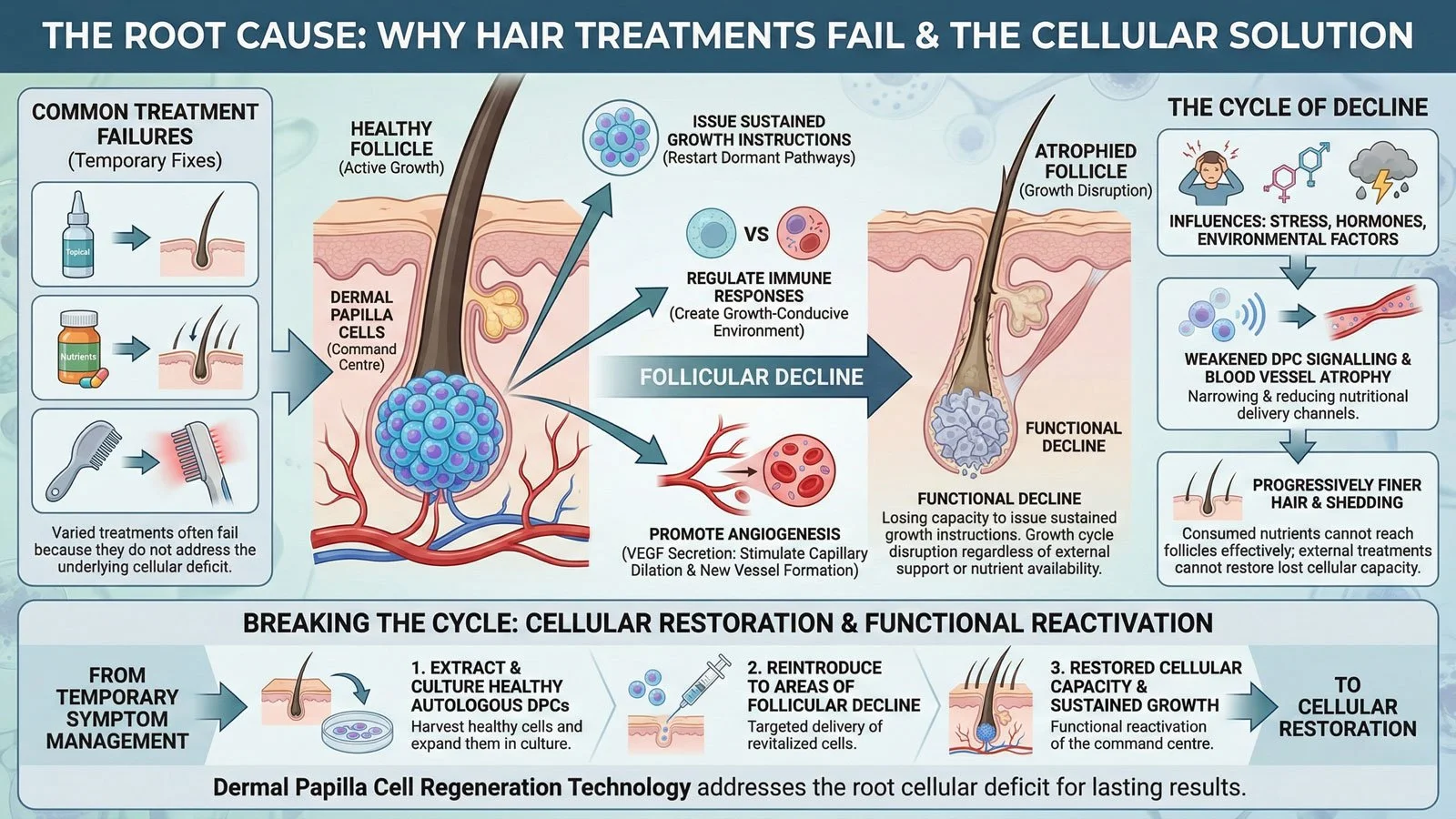
The Root Cause: Dermal Papilla Cell Decline
These varied treatment failures share a common factor. None address the underlying cellular deficit. When follicles atrophy, their command centre loses capacity to issue sustained growth instructions. Dermal papilla cells govern follicular function, and when these cells experience functional decline, growth cycle disruption occurs regardless of external support or nutrient availability.
Dermal papilla cells govern follicular function through multiple mechanisms. They activate regeneration by secreting growth signals that restart dormant proliferation pathways. They regulate immune responses, creating microenvironments conducive to growth rather than inflammation. They promote angiogenesis through vascular endothelial growth factor secretion, stimulating capillary dilation and new blood vessel formation that enhances nutrient delivery.
When stress, hormones, environmental factors or other influences cause follicular decline, dermal papilla cell signalling weakens. Blood vessels atrophy, narrowing and reducing nutritional delivery channels. Hair becomes progressively finer and more prone to shedding. In this state, consumed nutrients cannot reach follicles effectively, and external treatments cannot restore lost cellular capacity.
The Solution: Cellular Regeneration Technology
Breaking the cycle of treatment recurrence requires fundamental approach changes. Moving from temporary symptom management to cellular restoration and functional reactivation becomes essential. Dermal papilla cell regeneration technology extracts and cultures healthy autologous cells, then reintroduces them to areas of follicular decline.
This approach activates follicular vitality by restarting growth cycles, rebuilds scalp microenvironments to create favourable conditions, and stimulates vascular expansion to provide sustained nutritional supply. By awakening dermal papilla cells and restoring their capacity to issue growth instructions, follicles can resume autonomous, healthy growth rhythms rather than depending on continuous external support.
Effective intervention must address root causes rather than symptoms. Only by restoring the cellular command centre that governs follicular function can treatments and nutrition work synergistically. This enables follicles to fully receive and utilise available resources whilst maintaining self-sustaining regenerative capacity.
ReGrowth Biotech, powered by Re-Stem Biotech's cellular therapy expertise, specialises in advanced hair restoration treatments that harness the body's natural regenerative capabilities. Our D.P.G. technology represents the evolution from traditional hair treatments to cellular regeneration approaches.
Important Notice: This content is provided for educational purposes and general information. Individual treatment outcomes may vary, and all medical decisions should be made in consultation with qualified healthcare professionals. The information presented does not constitute medical advice or guarantees regarding treatment results.